

The fluorescent lights of a convenience store flicker overhead. It’s 2 AM in Seoul’s Geumga Plaza, and Vincenzo Cassano—Italian consigliere, sharp-suited lawyer, man who has dined in the finest restaurants of Milan—stands frozen in the instant noodle aisle.
He picks up a black package. Then an orange one. His brow furrows.
“You mix them,” says the store clerk, not looking up from her phone. “Chapagetti and Neoguri. Together.”
Vincenzo stares at her like she’s just suggested putting pineapple on pizza. But something in his eyes shifts. Curiosity, perhaps. Or hunger.
This is how empires fall. Not with a bang, but with a slurp.
The Dish That Conquered Two Worlds
Before Vincenzo brought Jjapaguri back into the spotlight in 2021, another Korean production had already introduced this unlikely noodle marriage to global audiences. You might remember a certain wealthy family in Parasite (2019), frantically preparing ram-don while their employers’ car pulled into the driveway.
Director Bong Joon-ho’s Oscar-winning film sparked a worldwide obsession. Suddenly, Korean grocery stores couldn’t keep Chapagetti and Neoguri on the shelves. Food bloggers scrambled to decode the recipe. The humble combination of two instant noodles had become an international phenomenon.
But here’s what makes Jjapaguri so fascinating: it’s not restaurant food. It’s not even traditional home cooking. It’s pure Korean ingenuity—the kind that happens at midnight when you’re hungry and your pantry options are limited.
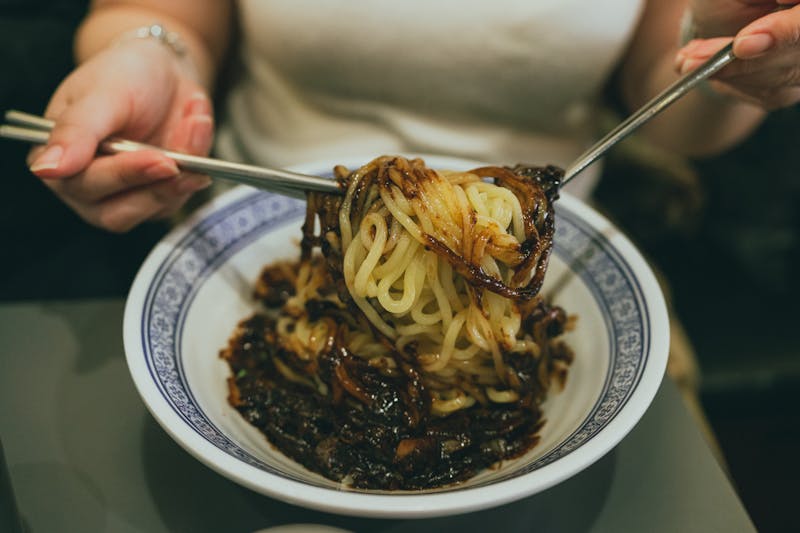 Jjajangmyeon—the black bean noodle base that gives Jjapaguri its signature color and umami depth
Understanding Jjapaguri: A Marriage of Opposites
The name itself tells the story. Jjapaguri is a portmanteau of Chapagetti (짜파게티) and Neoguri (너구리). In Western media, it’s often called Ram-don—a translation that appeared in Parasite’s subtitles and stuck.
But what makes this combination work?
| Noodle | Character | Flavor Profile |
|---|---|---|
| Chapagetti | Thick, chewy | Black bean sauce, savory-sweet, umami-rich |
| Neoguri | Thin, wavy | Spicy seafood broth, kelp essence, heat |
Alone, each noodle is satisfying. Together, they create something greater than the sum of their parts. The black bean sauce gains depth from the seafood broth. The spiciness cuts through the richness. The contrasting textures—thick and thin, chewy and slippery—keep every bite interesting.
It’s chaos. It’s harmony. It’s very, very Korean.
The Recipe: Vincenzo’s Late-Night Jjapaguri
Ingredients
Essential
- 1 pack Chapagetti (짜파게티)
- 1 pack Neoguri (너구리) - spicy version recommended
- 3 cups water (600ml)
- 1 egg (optional but highly recommended)
The Parasite Upgrade
- 150g beef sirloin or ribeye, cubed (for the hanu version)
- 1 tablespoon vegetable oil
- Pinch of salt and pepper
Optional Garnishes
- Green onions, sliced
- Sesame seeds
- A drizzle of sesame oil
Equipment
- One medium pot (the slightly dented kind, if you want authenticity)
- Chopsticks for stirring
- A bowl large enough for your ambitions
Step-by-Step Instructions
Step 1: Prepare Your Protein (Optional)
If you’re making the Parasite-style hanu version, start here. Cut your beef into bite-sized cubes—about 1-inch pieces work well.
Heat oil in your pot over high heat until it shimmers. Add beef cubes in a single layer. Don’t touch them. Let them sear for 60-90 seconds until a golden crust forms, then flip and repeat.
Vincenzo’s Note: In Italy, we would never rush a sear. The Maillard reaction doesn’t negotiate.
Remove beef and set aside. Don’t wash the pot—those brown bits are flavor.
Step 2: Boil the Water
Add 3 cups of water to your pot (with those beautiful beef remnants still clinging to the bottom). Bring to a rolling boil over high heat.
This is important: use slightly less water than the combined package instructions suggest. Jjapaguri should be saucy, not soupy. We’re making noodles, not broth.
Step 3: Cook the Noodles
Once boiling, add both noodle blocks. Let them cook for 4 minutes, stirring occasionally to separate the strands.
Here’s where technique matters: don’t just dump and wait. Use your chopsticks to gently loosen the noodles as they soften. They should cook evenly, not in clumps.
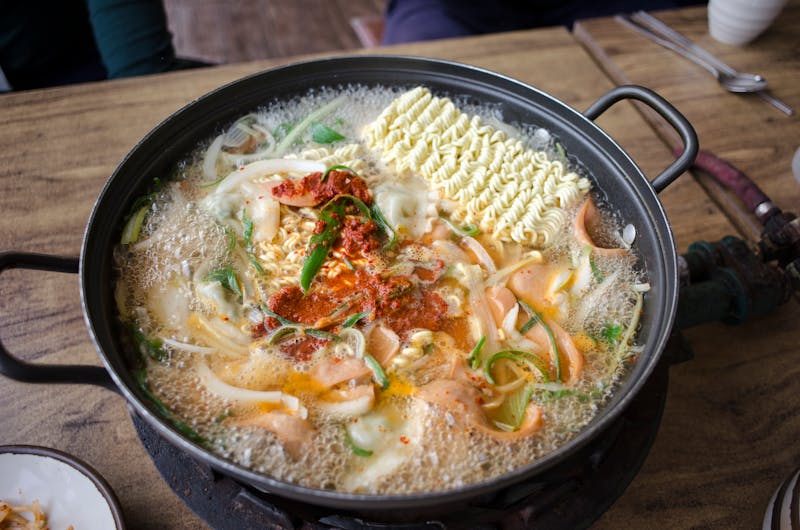 The moment of transformation—noodles bubbling in spicy broth
Step 4: Add the Flavor Packets
With about 1 minute of cooking time left:
- Add the Chapagetti black bean sauce packet (the oil packet too)
- Add the Neoguri soup powder - but only half of it
- Add the Neoguri flakes packet (the vegetable bits)
Stir vigorously. The sauce should coat every strand, turning the water into a glossy, dark mixture.
Pro Tip: Using all of the Neoguri powder makes the dish too salty. Half creates balance. Trust the Korean home cooks who perfected this ratio through trial and error.
Step 5: The Final Touches
Return your seared beef to the pot (if using). Toss to combine.
If adding an egg, you have two options:
- Soft egg: Create a well in the center, crack the egg in, cover for 30 seconds, then break and stir
- Mixed egg: Crack directly into noodles and stir for a silkier sauce
Step 6: Plate and Serve
Transfer to a bowl. Garnish with green onions and sesame seeds if desired. Eat immediately.
Jjapaguri waits for no one. The noodles will continue absorbing sauce as they sit, going from perfect to gummy in minutes.
Pro Tips from Korean Home Cooks
The Water Ratio Secret
Every Korean ajumma knows this: instant noodles are about water management. The packages overestimate. For Jjapaguri, use about 80% of the total recommended water from both packages combined. You can always add more. You can’t take it back.
The Timing Truth
Noodles should be slightly underdone when you add the sauce packets. The residual heat and stirring time will finish cooking them. Perfectly chewy noodles come from knowing when to stop.
The Leftovers Reality
There are no leftovers. Jjapaguri doesn’t reheat well—the noodles absorb everything and become mushy. Make only what you’ll eat. This is a feature, not a bug. It forces you to be present.
FAQ
What’s the difference between Jjapaguri and Ram-don?
They’re the same dish. Jjapaguri is the Korean name (짜파구리), while Ram-don is the English translation created for the Parasite subtitles. Korean audiences found the translation amusing—it’s not a term anyone in Korea actually uses.
Can I make Jjapaguri without beef?
Absolutely. The beef addition is the “rich family” version from Parasite. Traditional Jjapaguri is just the two noodles combined—no meat required. It’s equally delicious and far more accessible.
Where can I buy Chapagetti and Neoguri outside Korea?
Most Asian grocery stores stock them. Online retailers like Amazon, H-Mart (US), and various Asian food websites ship internationally. Look in the Korean instant noodle section, not the Japanese one.
Is Jjapaguri very spicy?
Moderately. Neoguri brings heat, but it’s balanced by the black bean sauce. If you’re sensitive to spice, use the mild (순한맛) version of Neoguri, or use even less of the soup powder.
Can I use other noodle brands as substitutes?
Purists would say no. The specific texture and flavor profiles of Chapagetti and Neoguri create the authentic taste. That said, any black bean noodle + spicy seafood noodle combination will get you in the neighborhood.
Why do Koreans mix instant noodles?
It started as dorm room experimentation and became culinary tradition. Mixing noodles (ramyeon combinations) is a beloved Korean practice—Jjapaguri just happens to be the most famous example.
How many calories are in Jjapaguri?
Without beef, approximately 900-1000 calories for the full two-pack serving. With beef, add another 200-300 calories. This is not diet food. This is comfort food.
The Last Word
It’s 3 AM now. Vincenzo has returned to his penthouse, Italian leather shoes discarded by the door, designer suit jacket draped carelessly over a chair worth more than most people’s cars.
He sits on the floor—the floor—holding a pot of Jjapaguri. No bowl. No pretense. Just a man, his chopsticks, and the steam rising from black-coated noodles.
Outside, Seoul glitters like scattered diamonds. Somewhere below, Geumga Plaza sleeps, its convenience store the unlikely birthplace of this moment.
Vincenzo takes a bite. Then another. The noodles are perfect—chewy, saucy, with just enough heat to remind him he’s alive.
He thinks about Milan. About white tablecloths and sommelier recommendations and courses that arrive in careful sequence. About a life measured in Michelin stars and wine vintages.
Then he thinks about this: a 3,000-won dish made from two instant noodle packages, eaten alone in the dark, so good it makes him close his eyes.
Some things, it turns out, don’t need to be complicated to be perfect.
Craving more K-Drama comfort food? Try our Crash Landing on You Ramyeon recipe—another late-night classic that proves the best meals are often the simplest.